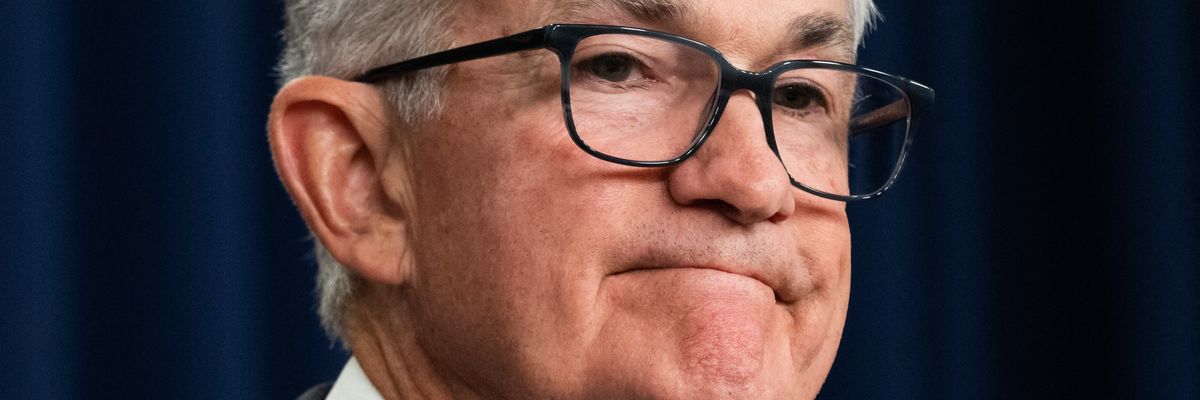
Federal Reserve Board Chairman Jerome Powell speaks during a news conference in Washington, D.C. on July 26, 2023.
Ignoring Warnings of Mass Job Loss, Fed Hikes Rates to Highest Level in Decades
"The dangerous reflex to hike rates, no matter the causes of inflation, is both a policy failure and a failure to imagine a world in which workers are anything other than expendable," said one economist.
Progressives on Wednesday rebuked the U.S. Federal Reserve for raising interest rates by another 25 basis points, arguing that the move threatens to throw millions of people out of work while failing to address the root causes of inflation.
Wednesday's interest rate hike—the 11th in 16 months—pushes benchmark borrowing costs to a target range of 5.25%-5.5%, their highest level since early 2001. It also ignores the advice of numerous academics and lawmakers who have long contended that job-killing rate hikes are incapable of tackling the corporate price gouging that is contributing significantly to the cost-of-living crisis.
Last month, the Fed announced that it would temporarily pause rate hikes after 10 consecutive increases since March 2022. As inflation showed signs of easing, a chorus of economic experts urged the nation's central bank to maintain the freeze, warning that a return to the status quo ante could needlessly push the economy into a recession. Wednesday's widely anticipated resumption of rate increases set off a firestorm of criticism.
"The Fed should end its rate hiking campaign for good."
"The Fed's unprecedented interest rate hike spree has done little to curb corporate price gouging," Liz Zelnick, director of Economic Security & Corporate Power at Accountable.US, said in a statement. "Instead, it's made it way too expensive for many average Americans to borrow money."
"No thanks to the Fed, fewer Americans are able to buy homes or new cars, and manufacturing jobs are less in demand," Zelnick noted. "For the Fed to raise rates again after a brief pause is like ripping the bandages off deep economic wounds that haven't begun to heal."
In a letter sent to Powell on Tuesday, the first of the two-day Federal Open Market Committee meeting, Sen. Elizabeth Warren (D-Mass.) lamented that the unemployment rate for Black workers jumped 1.3 percentage points to 6% in June, potentially signaling imminent trouble for the labor market as a whole.
"This recent data is alarming and underscores the dangers of the Fed's aggressive rate-hike campaign," Warren wrote. "Extensive research shows that Black workers are usually among the first to lose their jobs when the labor market falters. Accordingly, sharp increases in Black unemployment can be 'a strong predictor of an impending recession.'"
In a Wednesday statement, California Community Builders CEO Adam Briones said that Powell "needs to be more forthright about the communities who will be collateral damage from Fed's chosen inflation-fighting tool."
"Inducing a national unemployment rate of over 4% by the end of the year, as the Fed projects, will likely create close to 8% Black unemployment," said Briones. "That's hardly the 'soft landing' economists are so fond of."
At the start of the Fed's monthslong campaign to lift interest rates, Powell admitted that his goal was to "get wages down." According to Powell, workers' rising pay—the product of low unemployment, which increases labor's bargaining power—is to blame for rising prices, so the solution is to increase unemployment, which will decrease wages and then prices.
Powell appears to be sticking to this widely discredited theory of a wage-price spiral despite mounting evidence of profit-led inflation.
A growing body of work has shown that the current cost-of-living crisis is the outcome of a combination of nonwage factors. Notably, the Covid-19 pandemic and Russia's invasion of Ukraine both disrupted international supply chains that had been rendered fragile by decades of neoliberal globalization. Highly consolidated corporations, meanwhile, have capitalized on myriad emergencies to justify price hikes that far outpace the increased costs of doing business. As a result, windfall profits soared to $1 trillion per year in 2021 and 2022.
"For the Fed to raise rates again after a brief pause is like ripping the bandages off deep economic wounds that haven't begun to heal."
"Chair Powell and the Fed continue to push the false choice peddled by inflation hawks that we have to choose between a strong labor market and lower prices," Groundwork Collaborative executive director Lindsay Owens said Tuesday in a statement. "The data show that we can have both."
"The dangerous reflex to hike rates, no matter the causes of inflation, is both a policy failure and a failure to imagine a world in which workers are anything other than expendable," Owens added. "The Fed should end its rate hiking campaign for good."
That sentiment was echoed by Zelnick.
"Rather than jeopardize millions of jobs and keep families from getting ahead, the Fed should take a seat and let Congress go after corporate profiteers driving up costs," said Zelnick.
The Emergency Price Stabilization Act that Rep. Jamaal Bowman (D-N.Y.) introduced last August would empower the federal government to ease the cost-of-living crisis through targeted price controls.
The legislation was not brought to the floor when Democrats held the House. Now that the chamber is controlled by Republicans, its passage appears even less likely.
An Urgent Message From Our Co-Founder
Dear Common Dreams reader, It’s been nearly 30 years since I co-founded Common Dreams with my late wife, Lina Newhouser. We had the radical notion that journalism should serve the public good, not corporate profits. It was clear to us from the outset what it would take to build such a project. No paid advertisements. No corporate sponsors. No millionaire publisher telling us what to think or do. Many people said we wouldn't last a year, but we proved those doubters wrong. Together with a tremendous team of journalists and dedicated staff, we built an independent media outlet free from the constraints of profits and corporate control. Our mission has always been simple: To inform. To inspire. To ignite change for the common good. Building Common Dreams was not easy. Our survival was never guaranteed. When you take on the most powerful forces—Wall Street greed, fossil fuel industry destruction, Big Tech lobbyists, and uber-rich oligarchs who have spent billions upon billions rigging the economy and democracy in their favor—the only bulwark you have is supporters who believe in your work. But here’s the urgent message from me today. It's never been this bad out there. And it's never been this hard to keep us going. At the very moment Common Dreams is most needed, the threats we face are intensifying. We need your support now more than ever. We don't accept corporate advertising and never will. We don't have a paywall because we don't think people should be blocked from critical news based on their ability to pay. Everything we do is funded by the donations of readers like you. When everyone does the little they can afford, we are strong. But if that support retreats or dries up, so do we. Will you donate now to make sure Common Dreams not only survives but thrives? —Craig Brown, Co-founder |
Progressives on Wednesday rebuked the U.S. Federal Reserve for raising interest rates by another 25 basis points, arguing that the move threatens to throw millions of people out of work while failing to address the root causes of inflation.
Wednesday's interest rate hike—the 11th in 16 months—pushes benchmark borrowing costs to a target range of 5.25%-5.5%, their highest level since early 2001. It also ignores the advice of numerous academics and lawmakers who have long contended that job-killing rate hikes are incapable of tackling the corporate price gouging that is contributing significantly to the cost-of-living crisis.
Last month, the Fed announced that it would temporarily pause rate hikes after 10 consecutive increases since March 2022. As inflation showed signs of easing, a chorus of economic experts urged the nation's central bank to maintain the freeze, warning that a return to the status quo ante could needlessly push the economy into a recession. Wednesday's widely anticipated resumption of rate increases set off a firestorm of criticism.
"The Fed should end its rate hiking campaign for good."
"The Fed's unprecedented interest rate hike spree has done little to curb corporate price gouging," Liz Zelnick, director of Economic Security & Corporate Power at Accountable.US, said in a statement. "Instead, it's made it way too expensive for many average Americans to borrow money."
"No thanks to the Fed, fewer Americans are able to buy homes or new cars, and manufacturing jobs are less in demand," Zelnick noted. "For the Fed to raise rates again after a brief pause is like ripping the bandages off deep economic wounds that haven't begun to heal."
In a letter sent to Powell on Tuesday, the first of the two-day Federal Open Market Committee meeting, Sen. Elizabeth Warren (D-Mass.) lamented that the unemployment rate for Black workers jumped 1.3 percentage points to 6% in June, potentially signaling imminent trouble for the labor market as a whole.
"This recent data is alarming and underscores the dangers of the Fed's aggressive rate-hike campaign," Warren wrote. "Extensive research shows that Black workers are usually among the first to lose their jobs when the labor market falters. Accordingly, sharp increases in Black unemployment can be 'a strong predictor of an impending recession.'"
In a Wednesday statement, California Community Builders CEO Adam Briones said that Powell "needs to be more forthright about the communities who will be collateral damage from Fed's chosen inflation-fighting tool."
"Inducing a national unemployment rate of over 4% by the end of the year, as the Fed projects, will likely create close to 8% Black unemployment," said Briones. "That's hardly the 'soft landing' economists are so fond of."
At the start of the Fed's monthslong campaign to lift interest rates, Powell admitted that his goal was to "get wages down." According to Powell, workers' rising pay—the product of low unemployment, which increases labor's bargaining power—is to blame for rising prices, so the solution is to increase unemployment, which will decrease wages and then prices.
Powell appears to be sticking to this widely discredited theory of a wage-price spiral despite mounting evidence of profit-led inflation.
A growing body of work has shown that the current cost-of-living crisis is the outcome of a combination of nonwage factors. Notably, the Covid-19 pandemic and Russia's invasion of Ukraine both disrupted international supply chains that had been rendered fragile by decades of neoliberal globalization. Highly consolidated corporations, meanwhile, have capitalized on myriad emergencies to justify price hikes that far outpace the increased costs of doing business. As a result, windfall profits soared to $1 trillion per year in 2021 and 2022.
"For the Fed to raise rates again after a brief pause is like ripping the bandages off deep economic wounds that haven't begun to heal."
"Chair Powell and the Fed continue to push the false choice peddled by inflation hawks that we have to choose between a strong labor market and lower prices," Groundwork Collaborative executive director Lindsay Owens said Tuesday in a statement. "The data show that we can have both."
"The dangerous reflex to hike rates, no matter the causes of inflation, is both a policy failure and a failure to imagine a world in which workers are anything other than expendable," Owens added. "The Fed should end its rate hiking campaign for good."
That sentiment was echoed by Zelnick.
"Rather than jeopardize millions of jobs and keep families from getting ahead, the Fed should take a seat and let Congress go after corporate profiteers driving up costs," said Zelnick.
The Emergency Price Stabilization Act that Rep. Jamaal Bowman (D-N.Y.) introduced last August would empower the federal government to ease the cost-of-living crisis through targeted price controls.
The legislation was not brought to the floor when Democrats held the House. Now that the chamber is controlled by Republicans, its passage appears even less likely.
Progressives on Wednesday rebuked the U.S. Federal Reserve for raising interest rates by another 25 basis points, arguing that the move threatens to throw millions of people out of work while failing to address the root causes of inflation.
Wednesday's interest rate hike—the 11th in 16 months—pushes benchmark borrowing costs to a target range of 5.25%-5.5%, their highest level since early 2001. It also ignores the advice of numerous academics and lawmakers who have long contended that job-killing rate hikes are incapable of tackling the corporate price gouging that is contributing significantly to the cost-of-living crisis.
Last month, the Fed announced that it would temporarily pause rate hikes after 10 consecutive increases since March 2022. As inflation showed signs of easing, a chorus of economic experts urged the nation's central bank to maintain the freeze, warning that a return to the status quo ante could needlessly push the economy into a recession. Wednesday's widely anticipated resumption of rate increases set off a firestorm of criticism.
"The Fed should end its rate hiking campaign for good."
"The Fed's unprecedented interest rate hike spree has done little to curb corporate price gouging," Liz Zelnick, director of Economic Security & Corporate Power at Accountable.US, said in a statement. "Instead, it's made it way too expensive for many average Americans to borrow money."
"No thanks to the Fed, fewer Americans are able to buy homes or new cars, and manufacturing jobs are less in demand," Zelnick noted. "For the Fed to raise rates again after a brief pause is like ripping the bandages off deep economic wounds that haven't begun to heal."
In a letter sent to Powell on Tuesday, the first of the two-day Federal Open Market Committee meeting, Sen. Elizabeth Warren (D-Mass.) lamented that the unemployment rate for Black workers jumped 1.3 percentage points to 6% in June, potentially signaling imminent trouble for the labor market as a whole.
"This recent data is alarming and underscores the dangers of the Fed's aggressive rate-hike campaign," Warren wrote. "Extensive research shows that Black workers are usually among the first to lose their jobs when the labor market falters. Accordingly, sharp increases in Black unemployment can be 'a strong predictor of an impending recession.'"
In a Wednesday statement, California Community Builders CEO Adam Briones said that Powell "needs to be more forthright about the communities who will be collateral damage from Fed's chosen inflation-fighting tool."
"Inducing a national unemployment rate of over 4% by the end of the year, as the Fed projects, will likely create close to 8% Black unemployment," said Briones. "That's hardly the 'soft landing' economists are so fond of."
At the start of the Fed's monthslong campaign to lift interest rates, Powell admitted that his goal was to "get wages down." According to Powell, workers' rising pay—the product of low unemployment, which increases labor's bargaining power—is to blame for rising prices, so the solution is to increase unemployment, which will decrease wages and then prices.
Powell appears to be sticking to this widely discredited theory of a wage-price spiral despite mounting evidence of profit-led inflation.
A growing body of work has shown that the current cost-of-living crisis is the outcome of a combination of nonwage factors. Notably, the Covid-19 pandemic and Russia's invasion of Ukraine both disrupted international supply chains that had been rendered fragile by decades of neoliberal globalization. Highly consolidated corporations, meanwhile, have capitalized on myriad emergencies to justify price hikes that far outpace the increased costs of doing business. As a result, windfall profits soared to $1 trillion per year in 2021 and 2022.
"For the Fed to raise rates again after a brief pause is like ripping the bandages off deep economic wounds that haven't begun to heal."
"Chair Powell and the Fed continue to push the false choice peddled by inflation hawks that we have to choose between a strong labor market and lower prices," Groundwork Collaborative executive director Lindsay Owens said Tuesday in a statement. "The data show that we can have both."
"The dangerous reflex to hike rates, no matter the causes of inflation, is both a policy failure and a failure to imagine a world in which workers are anything other than expendable," Owens added. "The Fed should end its rate hiking campaign for good."
That sentiment was echoed by Zelnick.
"Rather than jeopardize millions of jobs and keep families from getting ahead, the Fed should take a seat and let Congress go after corporate profiteers driving up costs," said Zelnick.
The Emergency Price Stabilization Act that Rep. Jamaal Bowman (D-N.Y.) introduced last August would empower the federal government to ease the cost-of-living crisis through targeted price controls.
The legislation was not brought to the floor when Democrats held the House. Now that the chamber is controlled by Republicans, its passage appears even less likely.